Owens Corning Attic Insulation in Anaheim: A Homeowner’s Guide
Owens Corning makes three distinct attic insulation products: EcoTouch fiberglass batts, ProPink blown-in fiberglass, and closed-cell spray foam. In Anaheim’s heat-dominant climate, each performs differently, and the right choice depends on your attic’s shape, your ductwork layout, and whether you’re doing a clean-build or a retrofit. If you’d rather not sort through product specs on your own, call (866) 435-9603 and we’ll walk you through it.
Most Anaheim homeowners end up with Owens Corning because a contractor said “I use Owens Corning” and left it at that. But “Owens Corning” is a manufacturer, not a product. The company’s batting line performs differently from its blown-in line, and neither performs like its spray foam. Treating them as interchangeable is how attics end up under-insulated in August when the roof deck hits 140 degrees and the air conditioner runs from noon to midnight.
What Owens Corning Actually Makes for Attics
Owens Corning is one of the most recognized insulation brands in the country, which means it’s also one of the most over-specified: recommended by habit rather than by fit. Understanding the product line is the first step to knowing whether it’s actually right for your attic.
Here’s what Owens Corning sells for attic applications, in plain terms:
- EcoTouch fiberglass batts: Pre-cut blankets, typically R-30 or R-38, with a kraft-paper or foil facing. They’re designed for open, regularly spaced joist bays. In Anaheim attics with standard 16- or 24-inch framing, they install quickly and hold their shape. Batts are not the right product for attics with odd framing, shallow bays, or lots of cross-bracing.
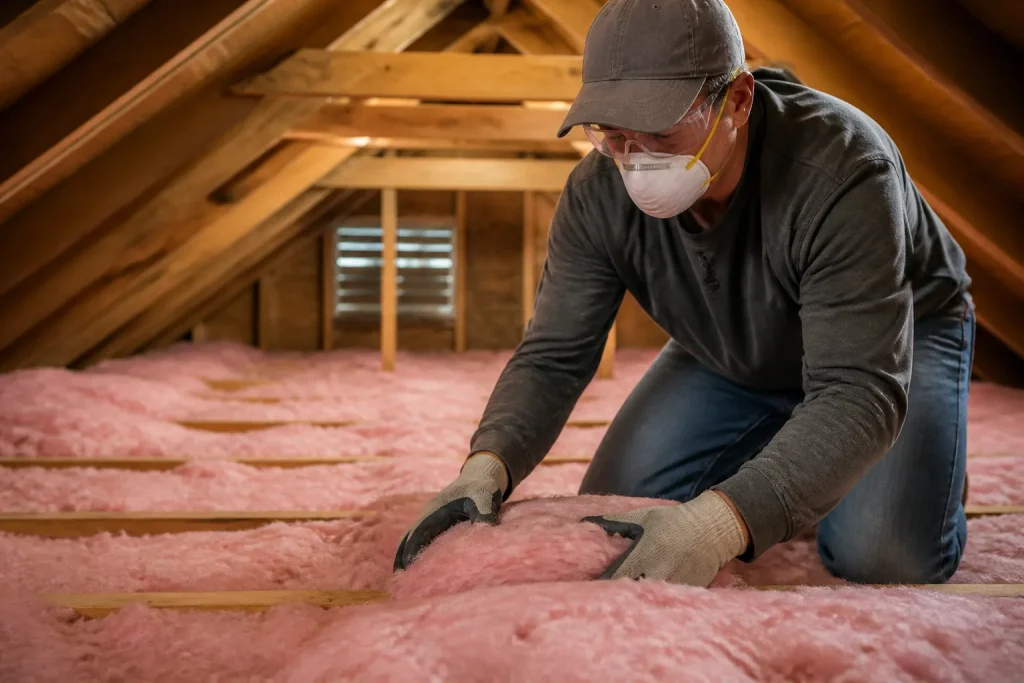
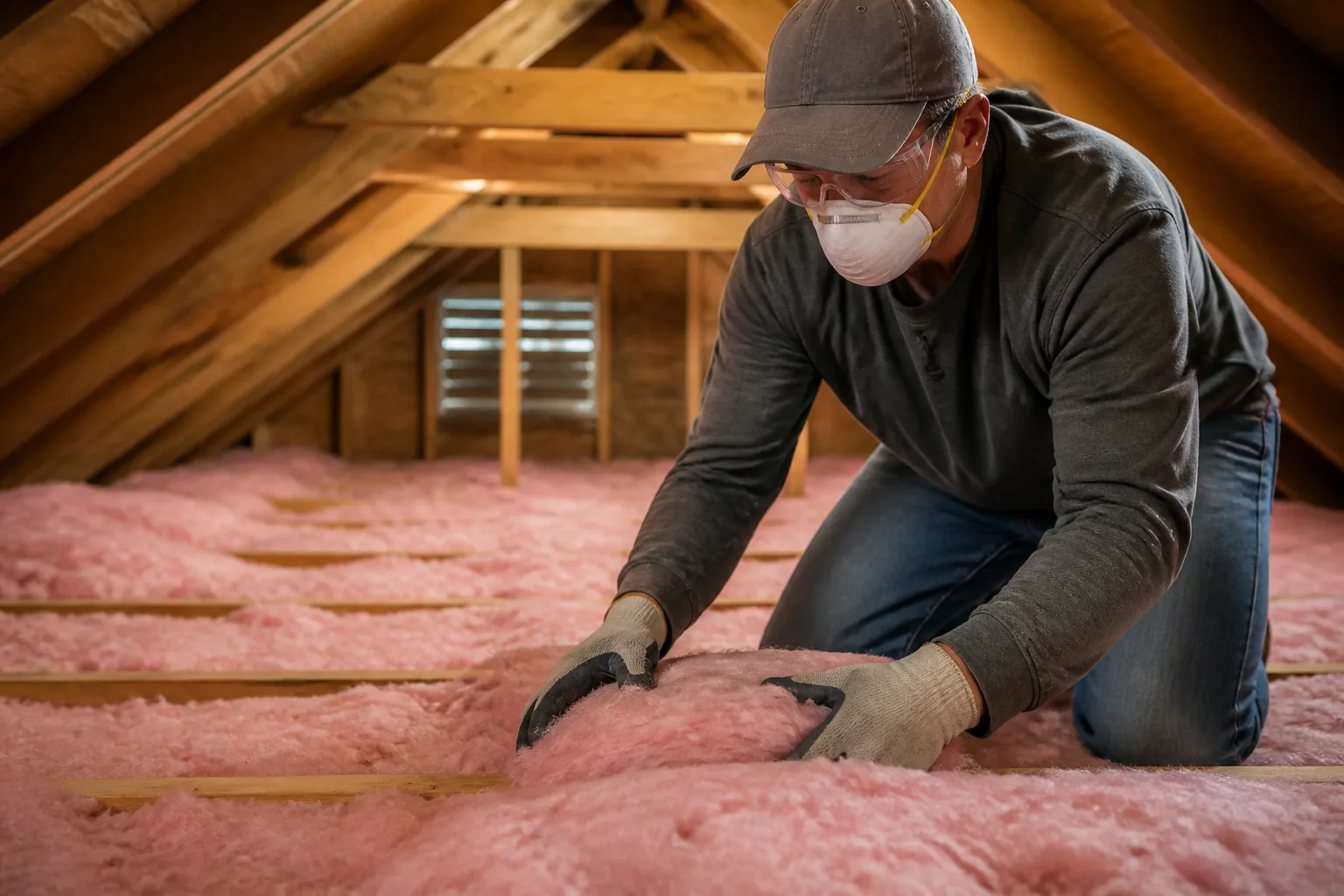
- ProPink blown-in fiberglass: Loose-fill fiberglass blown to a target depth using a machine. This is the product most Anaheim retrofits should consider, because it flows around obstructions, fills irregular cavities, and makes it easy to hit a uniform R-value across the whole attic floor. ProPink performs well in Anaheim because fiberglass doesn’t absorb moisture from coastal marine air the way cellulose can.
- Owens Corning closed-cell spray foam: A two-component foam that air-seals and insulates in one step. It’s applied to the roofline, not the attic floor. In Anaheim, where attics can become convection ovens, sealing and insulating the roofline keeps the attic itself inside the home’s thermal envelope, which protects any ducts or air handlers up there.
That’s the product landscape. Most homeowners only ever hear about one of them.
Climate Zone 10: Why Anaheim Heat Changes the Math
Anaheim sits in California climate zone 10, which the Department of Energy defines as a hot, semi-arid region with mild winters and long, sun-heavy summers. The building code’s insulation recommendation for zone 10 attic floors is R-30 to R-38 for fiber-based materials, and R-38 is common practice for new construction. That’s a floor, not a ceiling.
What the code table doesn’t capture is how Anaheim’s specific heat pattern stresses insulation. Roof deck temperatures in July and August routinely exceed 140 degrees. The attic air below that deck can sit at 115 to 125 degrees for hours. Radiant heat from the deck radiates down onto whatever is below it, including the insulation surface.
This is where material choice matters. Fiberglass batts lose effective R-value when compressed, and they also lose some performance when the temperature differential across them gets extreme. ProPink blown-in holds its specified R-value better across temperature swings, provided it’s blown at the correct density and not fluffed. Closed-cell spray foam, because it air-seals as well as insulates, stops the convection loop entirely. In Anaheim, we’ve measured attic temperatures drop from 135 degrees to under 100 after a roofline foam application, even before the air conditioner kicked on that day.
Fiberglass batts also don’t block radiant heat effectively. The heat that radiates off the underside of the roof deck passes through the batts into the living space below. Both blown-in fiberglass and foam do a better job of slowing radiant transfer, but for different reasons: blown-in adds mass and depth, while foam adds a sealed, reflective, closed-cell barrier.
Homes in Anaheim neighborhoods like Colony Park and The Highlands, where homes are older and framing varies from block to block, often need a mixed approach: batt in the regular bays, blown-in around the edges, or foam on a problem section of roofline. The product should follow the attic, not the other way around.
Where Owens Corning Excels in Anaheim (And Where It Doesn’t)
Owens Corning products genuinely excel in specific Anaheim situations. They’re not the best fit for every attic, and a contractor who says otherwise is selling you a brand, not a solution.
Where Owens Corning is the right call:
- New construction or clean retrofits with standard framing. EcoTouch batts install fast in regular bays and the faced version gives a clean vapor-control layer.
- Attics where blown-in R-38 is the target. ProPink hits the spec reliably and doesn’t settle in dry Anaheim conditions.
- Roofline insulation and duct zones. Owens Corning closed-cell foam air-seals and insulates in one pass, which is exactly what you want if your ducts live in the attic.
Where other brands win:
- Irregular or tight attics where Johns Manville’s loose-fill products flow more easily around tight chase corners and shallow bays.
- Sound attenuation between floors or rooms. Rockwool’s mineral wool, which we also install, outperforms fiberglass in both sound control and fire resistance. If your Anaheim home shares a wall with a busy street or if you’re converting an attic to living space, Rockwool is the conversation you should be having.
- Budget-focused fiberglass retrofits where CertainTeed’s blown-in line hits similar R-values at a lower material cost per square foot, for projects where every dollar matters.
We carry Owens Corning, Johns Manville, Knauf, Rockwool, and CertainTeed because no single brand fits every Anaheim attic. The right material for your home’s specific needs is a decision, not a default.
How to Verify Your Installer Is Actually Using Owens Corning
This is where it gets practical. Owens Corning is a specification brand: contractors quote it because homeowners recognize the name. Some installers quote Owens Corning and then substitute a lower-cost off-brand batt or blown-in product once the job starts. It’s the most common brand-swap we hear about from Anaheim homeowners who call us to inspect recent work.
Here’s how to verify what’s actually being installed:
- Ask for the product data sheet, not just the brand name. “Owens Corning” isn’t a product. Ask for the exact product: “EcoTouch R-38 faced batt” or “ProPink L77 loose-fill.” A sheet gives you a product code you can verify.
- Check the bag or batt in person before installation. Owens Corning bags and batt labels carry the Owens Corning logo and the R-value printed on the facing. If the installer won’t let you see the material before it goes in, that’s a red flag.
- Ask for the Owens Corning product warranty registration. Owens Corning warranties are tied to the product, and the installer should register the installation. If the contractor can’t offer that paperwork, ask why.
- Get the installed depth and R-value in writing. For blown-in, the R-value comes from depth and density, not brand. Verify what depth equals R-38 for that specific product and make sure the installer uses enough bags.
What the Owens Corning Warranty Covers (And What Voids It)
Owens Corning offers warranties on its insulation products, but the coverage is narrower than most Anaheim homeowners assume. The standard warranty covers defects in the product itself: failed binders, manufacturing defects, or product that doesn’t perform to the stated R-value in a lab setting. It does not cover installation errors.
This matters in Anaheim because heat accelerates material aging. Fiberglass doesn’t rot, but it can degrade if it’s been compressed, wet, or if the facing has delaminated in a hot attic. When warranty claims fail, the reason is almost always installation-related: the product was compressed below its stated thickness, the vapor retarder was installed facing the wrong way, or the material was substituted after the quote.
Common warranty voiders we’ve seen in Anaheim attics:
- Compression. Batts forced into shallow bays or under flooring lose R-value and the warranty won’t cover the performance loss.
- Moisture exposure. If a roof leak or condensation wets the insulation and the installer didn’t flag the moisture source, the product warranty doesn’t apply.
- Improper storage before install. Batts left outside or in a damp garage can grow mold before they ever reach your attic.
- Mixing products. Installing off-brand material alongside Owens Corning in the same cavity can void the warranty on the Owens Corning product.
The takeaway: the warranty is only as good as the installer’s honesty and workmanship. A brand name doesn’t protect you from a contractor who cuts corners.
Questions to Ask Any Contractor About Brand Selection
When you’re interviewing contractors for attic insulation in Anaheim, the brand conversation should sound like a diagnostic, not a sales pitch. Here are the questions we recommend homeowners ask, and the answers that should raise flags:
- “Why are you recommending Owens Corning for my attic instead of another brand?” A good answer references your attic’s specs: joist spacing, access, existing insulation, budget. A bad answer is “it’s what we use.” If the contractor can’t explain the fit, they’re recommending a habit.
- “Can you show me a side-by-side comparison with Johns Manville, CertainTeed, or Knauf for my project?” Material costs, R-value per inch, and installation method differ between brands. If the contractor refuses a comparison, you’re shopping a distributor’s margin, not your project’s needs.
- “How do you determine the right R-value for an Anaheim attic?” The answer should reference climate zone 10, existing insulation depth, and the home’s square footage. A vague “we always do R-38” is fine if the attic is standard, but it should be a starting point, not a reflexive answer.
- “What happens if my attic has to be partially re-opened later for electrical or HVAC work?” This exposes whether the contractor is thinking about your home’s long-term needs or just the final invoice.
- “Can I see the product bags or batts before installation?” If the answer is anything but “yes,” walk away.
One of the reasons Harbor Line Insulation carries eight brands across three installation methods is so the recommendation is driven by the project’s needs, not a limited product shelf. When a contractor only offers one brand, every attic looks like that brand’s job.
When to Call a Pro in Anaheim
Attic insulation is generally safer to handle than, say, garage door springs or electrical panels, but it’s still not a casual DIY project. The risks in Anaheim are heat, confined access, and invisible mistakes. A 140-degree attic in July is dangerous to work in for more than 20 minutes. Blown-in insulation requires a machine most homeowners don’t own and a density target that’s easy to miss. Batts that are cut wrong, compressed, or installed with gaps can cut effective R-value by 30 percent or more, and you won’t see the problem until your summer energy bill spikes.
We pulled one out of a garage over in West Anaheim last month: a homeowner had spent a weekend in his attic with big-box batts, and by the time he called us, the R-value was effectively half of what he’d paid for because he’d compressed the batts under some plywood decking. The advice: if you’re not sure, call before you spend the weekend up there.
Related services in Anaheim: Attic Insulation in Anaheim | Spray Foam Insulation in Anaheim | Blown In Insulation in Anaheim
Key Takeaways
- Owens Corning makes three distinct attic products: EcoTouch batts, ProPink blown-in, and closed-cell spray foam. They are not interchangeable.
- In Anaheim’s climate zone 10, blown-in fiberglass and roofline spray foam generally outperform batts in extreme summer heat, especially in irregular attics.
- Owens Corning excels in standard-bay new construction and clean retrofits. Other brands, like Johns Manville, Rockwool, and CertainTeed, win in specific niche applications.
- Verify the product data sheet, check the material before installation, and ask for warranty registration. Brand-swapping in Anaheim attics is common enough to warrant caution.
- Owens Corning’s warranty covers product defects, not installer mistakes. Most failed claims trace back to compression, moisture, or improper installation.
The Bottom Line
Owens Corning attic insulation is a proven, field-tested option for Anaheim homes, but the product line has more variation than most homeowners realize. The right choice depends on your attic’s framing, your ductwork location, and whether you’re insulating the floor or the roofline. In our experience, most Anaheim retrofits are best served by ProPink blown-in at R-38 or better, with closed-cell foam reserved for duct-heavy attics or living-space conversions. If you’re in Anaheim and need help, Harbor Line Insulation offers free estimates: call (866) 435-9603. Eight brands. One specialty. No filler work.
Frequently Asked Questions
For climate zone 10, R-30 is the minimum and R-38 is standard practice. If your Anaheim attic runs hotter than average or if ducts run through the attic, R-49 or a roofline foam application can be justified. Call (866) 435-9603 and we’ll tell you what your specific attic needs, no guesswork.
Not universally. Owens Corning products excel in standard framing and clean retrofits, while Johns Manville and CertainTeed can be better fits for irregular attics or budget-focused projects. Rockwool wins on fire resistance and sound control. The best brand is the one that matches your attic’s specific conditions. Our side-by-side comparisons during consultations are how homeowners in Anaheim actually find out which one that is.
For EcoTouch batts, most Anaheim homeowners see material and install in the $1.20 to $2.00 per square foot range. ProPink blown-in typically runs $1.50 to $2.50 per square foot installed, and closed-cell roofline foam is substantially higher, often $3.00 to $5.00 per square foot. These ranges shift based on attic access, existing insulation removal, and targeted R-value. Call (866) 435-9603 for a free, specific estimate.
Yes, for most batts and blown-in projects. A standard single-story Anaheim attic can be done in half a day. Roofline spray foam takes longer because the foam needs time to cure and the space needs ventilation during application. Whatever your timeline, we’ll be straightforward about it. Call (866) 435-9603 and we’ll tell you exactly when we can be there.
Written by the team at Harbor Line Insulation home, serving Anaheim since 2015.
Need Insulation Help?
Call Harbor Line Insulation — licensed & insured, here with fast after-hours help in Anaheim.
(866) 435-9603