
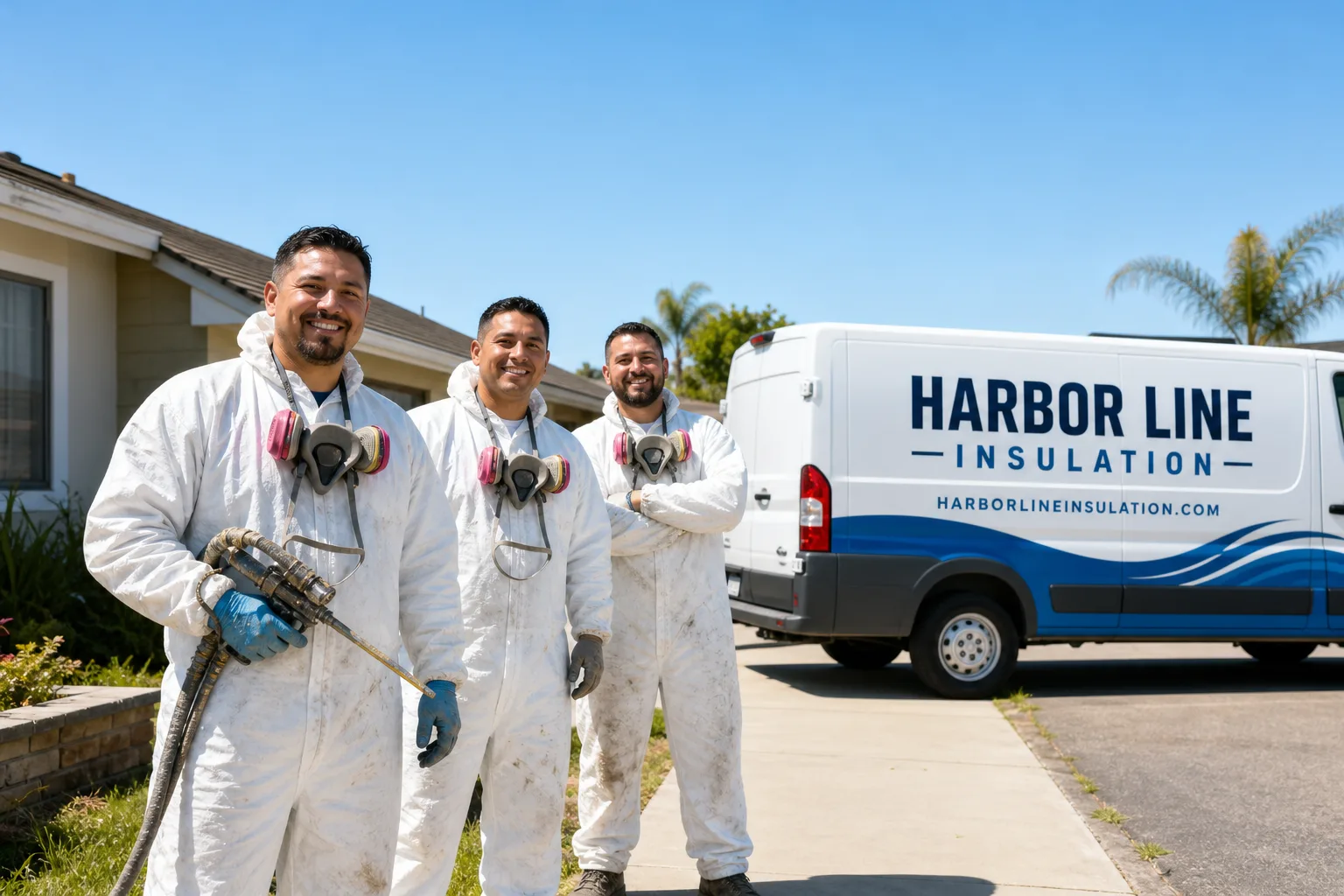
Fast, Reliable Spray Foam Insulation Across Hawaiian Gardens
Spray foam insulation in Hawaiian Gardens costs roughly $2,800 to $7,500 for a typical attic or garage retrofit, and most jobs are completed in a single day. The bigger frame here is that Hawaiian Gardens’s dense 2.5-square-mile grid of post-war tract homes creates access problems most insulation crews never deal with. Hose runs from the alley under low eaves. Attics you can’t stand up in. Neighbors’ roofs six feet from the wall you’re sealing.
Alan Bosworth and the Harbor Line Insulation crew know these streets. We stage equipment where it fits, not where a textbook says it should go. If you’re calling from Norwalk Boulevard or anywhere in the 90716, we can usually have someone at your door within 48 hours. Call (866) 435-9603 for a free estimate.
Why Harbor Line Insulation Is Hawaiian Gardens’s Preferred Spray Foam Insulation Company
Harbor Line Insulation is an insulation-only contractor. That’s not a marketing line – it means every truck, every toolbelt, and every product relationship we maintain exists for one purpose. We don’t do roofing. We don’t do HVAC. We insulate. And in Hawaiian Gardens specifically, that matters because the houses are tight, the attics are cramped, and a generalist crew will cut corners to get the job done before noon.
We carry products from eight industry-recognized brands, including Icynene, Demilec, and Owens Corning. That breadth lets us recommend a material based on your home’s actual conditions, not whatever happens to be in the truck. Our spray foam work includes open-cell and closed-cell systems, rim joist sealing, garage ceiling insulation, and roof deck applications. For a city like Hawaiian Gardens, where converted garages and shallow attics are the rule, that material flexibility is the difference between a fix that works and one that just covers the studs.
Alan has spent years working insulation across southeast LA County. He knows what salt air from the Long Beach shoreline does to garage hardware. He knows what a 1960s single-story on a 5,000-square-foot lot does when August hits. If you’re a homeowner in Hawaiian Gardens or a property manager overseeing older apartment stock along Carson Street, call us, and you’ll talk to someone who understands the specific problems this city throws at insulation.
Garage Spray Foam Insulation in Hawaiian Gardens
Garage Spray Foam Insulation in Hawaiian Gardens is one of the most impactful retrofits a homeowner here can make, because so many of the city’s original 1950s and 60s garages have been converted into living space, workshops, or home offices with zero insulation in the walls. The bare studs behind drywall become a radiant heat panel by mid-afternoon, pushing interior temperatures past 100°F in August. Spray foam applied directly to the wall cavities and overhead deck closes those gaps and stops the thermal transfer.
On a converted-garage job off a narrow corridor near the Lakewood edge of Hawaiian Gardens, our crew found the original 1960s garage walls were still bare studs behind drywall. The room hit 100°F by August afternoon. We flashed and sealed the wall cavities with closed-cell spray foam and capped the shallow attic deck with Icynene, which both closed the salt-air gaps around the old garage-door hardware and killed the radiant heat gain. The homeowner reported the room finally held its temperature through the afternoon.
Typical garage spray foam work here runs $1,200 to $2,800 depending on wall square footage and whether the ceiling deck is included. If the garage-door opening is staying, we pay specific attention to the framing around the tracks and springs, because that’s the seam where moisture and hot air leak for decades without anyone noticing.
Salt-Air Garage Hardware Sealing
Hawaiian Gardens sits close enough to the coast that salt-laced air works on steel all year. Garage-door springs, hinges, rollers, and fasteners here corrode years faster than they do inland. When foam goes in around those components, the goal is to seal the thermal gap without trapping moisture against already-rusting steel. That means flashing details, foam depth control, and knowing where to leave air movement.
Converted Garages and Hot August Rooms
Most Hawaiian Gardens garages converted to living space were never insulated at the time of conversion. The drywall went up right over open wall cavities. Homeowners only find out when August turns the room unusable. We air-seal the cavities with closed-cell foam, insulate the overhead deck, and close the rim joist ends where the slab meets the wall framing.
Closed Cell Spray Foam Insulation in Hawaiian Gardens
Closed Cell Spray Foam Insulation in Hawaiian Gardens is our standard recommendation for wall cavities, rim joists, and garage decks because it provides both an air seal and a vapor barrier in one application. In a place where shallow attics and tight wall cavities dominate, closed-cell foam’s higher R-value per inch (roughly R-6.5 to R-7) lets us hit code-adjacent performance in a fraction of the depth open-cell or batt products would need. Expect to pay $1.50 to $3.00 per board foot, with most Hawaiian Gardens wall or rim joist jobs landing between $2,400 and $5,200.
The salt-air issue matters here too. Closed-cell foam adds structural rigidity and resists moisture absorption, which means it does not wick harbor air into the cavity the way fiberglass or open-cell can. That’s the right tool when you’re sealing around corroding garage hardware or a shallow roof deck that sweats in the morning marine layer.
Rim Joist Sealing on Narrow Lots
Hawaiian Gardens homes sit shoulder-to-shoulder. The rim joist, the band of framing where your floor meets the foundation, is the primary entry point for outside air and the humidity that rides in with it. In this city’s narrow-lot tract homes, rim joists are often accessed through a crawl space or a low-rat basement, and the fix is a two-inch shot of closed-cell foam across every bay. We do this from the interior or exterior depending on access.
Shallow Attic Deck Sealing
Hawaiian Gardens attics are rarely walkable. The original post-WWII trusses leave maybe 18 to 24 inches of clearance at the peak. That means blow-in and batt work is limited, and spray foam applied to the roof deck is often the only way to meaningfully move the thermal boundary. Closed-cell foam on the deck, when paired with proper ventilation planning, converts the attic into semi-conditioned space and drops ceiling temperatures by 15 to 20 degrees in summer.
Trusted Brands We Service in Hawaiian Gardens
Harbor Line Insulation installs spray foam systems from Icynene and Demilec, two of the most specified closed- and open-cell foam brands in the industry. We also carry Owens Corning and GreenFiber products for blown-in and batt applications where those make more sense for the house. That matters in Hawaiian Gardens because the right answer is not always foam. Sometimes a shallow attic with good soffit ventilation is better served by a routed injection and cellulose. We’ll tell you which product actually solves your problem and why, side by side, during the estimate. Insulation is all we do, which means it’s all we’ve perfected.
Common Spray Foam Insulation Problems We See in Hawaiian Gardens Homes
- Salt-corroded garage-door hardware sealed under fresh foam: The coastal air near Hawaiian Gardens eats springs and hinges years earlier than inland. If a foam crew seals around those components without addressing the existing corrosion, moisture gets trapped against the steel and accelerates failure. We inspect and recommend galvanized or coated springs and stainless fasteners before foam goes in.
- Open-cell foam in a shower-wall cavity or below-grade rim joist: Open-cell breathes, but in Hawaiian Gardens’s humid marine mornings, it can hold moisture against framing in the wrong location. Closed-cell is the safer call for any cavity that faces soil or exterior moisture.
- Over-sealing the soffit-to-ridge ventilation path: These small-lot post-war homes depend on low-eave intake and ridge exhaust to keep the attic dry. Closed-cell foam sprayed too aggressively across the eave edge chokes that air path, and then you get moisture problems in the deck. It’s a balance, and foam crews that don’t know these houses get it wrong.
- Converted garages with insulated walls but skipped ceiling decks: We see this regularly. Homeowners insulate the walls, and the garage still bakes, because the flat roof or shallow attic overhead is the largest heat-gain surface. Foam has to go on the deck too, or the job is half done.
Pricing for Spray Foam Insulation in Hawaiian Gardens, CA
You’ll generally see open-cell spray foam at $0.80 to $1.50 per board foot and closed-cell at $1.50 to $3.00 per board foot in Hawaiian Gardens. A typical rim joist job lands between $1,800 and $3,400. A garage ceiling and wall retrofit runs $2,200 to $5,800. Full attic deck encapsulation on a 1,000-square-foot house sits in the $5,500 to $9,000 range depending on access. The dense-lot factor matters here too: if we have to stage hoses from the alley and run them 60 feet under low eaves to reach the attic hatch, that adds labor. We give exact, line-itemed pricing before any work starts. Call (866) 435-9603 and we’ll come measure, inspect, and quote it free.
We Also Serve Cities Near Hawaiian Gardens
Harbor Line Insulation regularly works in Los Alamitos, Cypress, La Palma, and Rossmoor, and we run crews into Hawaiian Gardens weekly. If you live in one of those neighboring communities and need Spray Foam Insulation, we bring the same material range and the same attention to tight-access retrofits. And if you’re reading this from Hawaiian Gardens, our Spray Foam Insulation in Hawaiian Gardens crew is local and ready.
Serving Hawaiian Gardens, CA — Our Local Coverage Area
We’re based in the Hawaiian Gardens area and know this community well. Use the map below to see our service coverage — if you’re nearby, we can almost certainly help.
FAQs About Spray Foam Insulation in Hawaiian Gardens
Because Hawaiian Gardens sits just a few miles from the coast, salt-laced air corrodes garage-door springs, hinges, rollers, and fasteners years faster than it does in places like Norwalk or Downey, and the dense lot lines mean most garages here are either converted living space or unconditioned heat traps. Foam that seals those cavities without trapping moisture against rusting steel is a specific fix. Call (866) 435-9603 for an inspection and quote.
Yes, but it requires a deliberate ventilation plan. Hawaiian Gardens tract homes from the 1950s and 60s have shallow attics that rely on soffit-to-ridge airflow to stay dry. We install baffles at the eave edge before foaming the deck, or we leave a maintained intake path and foam only to the baffle line. That preserves air movement while still moving the thermal boundary to the deck.
Closed-cell foam is the better choice in Hawaiian Gardens because it does not absorb moisture or wick humidity the way open-cell or fiberglass does. That means it won’t hold salty moisture against framing or corroding hardware. When we’re sealing around old garage-door steel, we always recommend closed-cell and a corrosion check on the hardware itself.
We typically use Icynene closed-cell for tight Hawaiian Gardens garage and accessory-building retrofits because it applies cleanly in confined cavities, cures fast, and delivers high R-value per inch. Demilec is our second specified closed-cell system and works well for larger deck applications. The brand depends on the specific cavity depth and the moisture profile of the structure.
We stage hoses from the street or alley, run them under low eaves, and work from the attic interior where possible. On Hawaiian Gardens lots where houses are separated by less than five feet, we also use drop cloths and guarded spray tips to protect the neighbor’s wall or roofline from overspray. It’s slower, but it’s the only way to do the job without creating a problem next door.
If you’re in Hawaiian Gardens and your attic, garage, or walls are fighting you, call Harbor Line Insulation at (866) 435-9603. Alan and the crew will come out, look at the actual conditions, and give you a straight answer on what this house needs. Free estimates. No pressure.
Written by Alan Bosworth, Owner at Harbor Line Insulation, serving Hawaiian Gardens and southeast LA County since the company’s founding.