
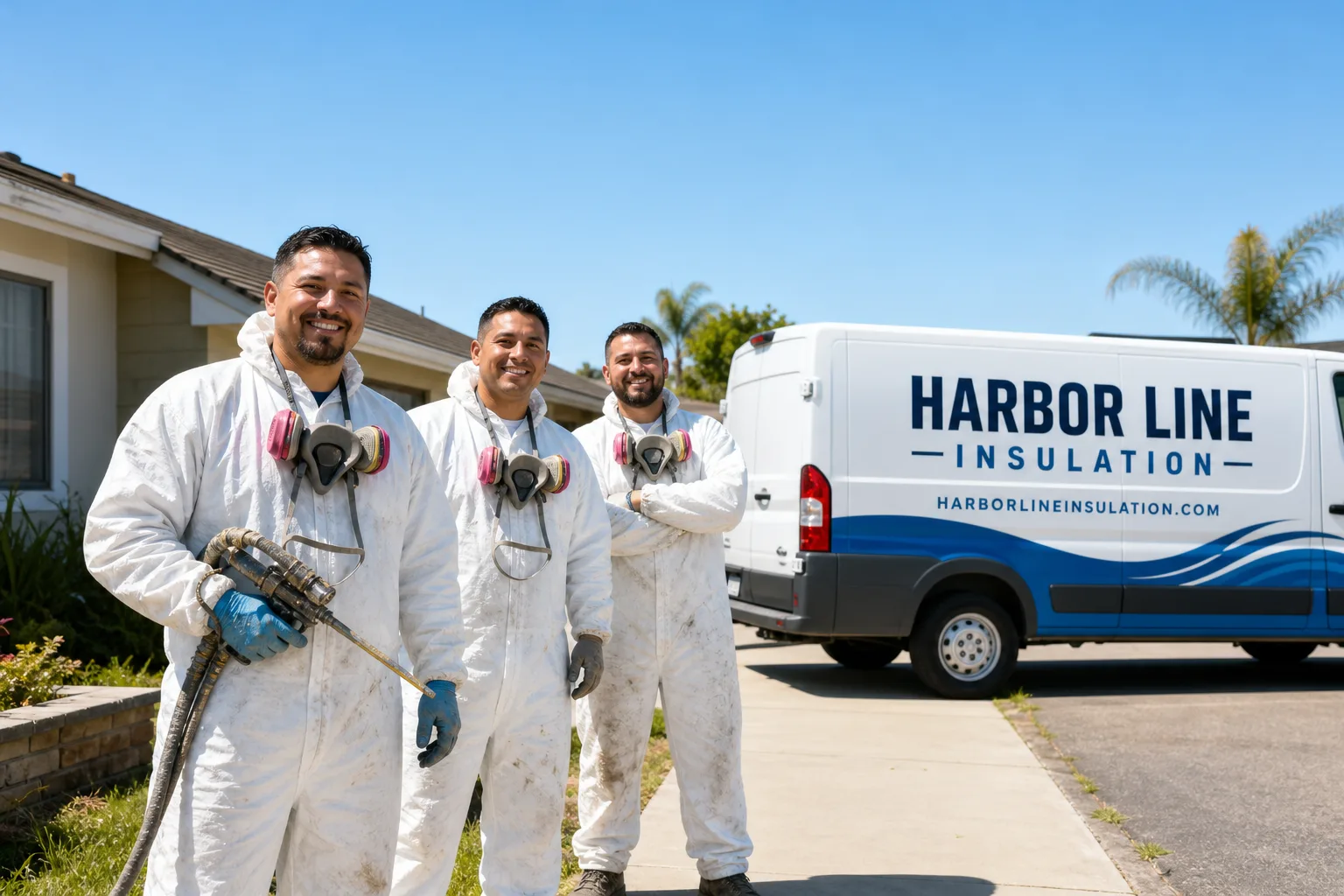
Fast, Reliable Spray Foam Insulation Across Fountain Valley
If you own a 1950s, 60s, or 70s ranch in Fountain Valley, your insulation was never designed for the way we live now. Most of these homes left the builder with R-0 paper-faced batts or bare wall cavities, and after sixty years of Santa Ana heat cycles, whatever’s left in there has sagged, compressed, or turned to dust. Spray foam insulation in Fountain Valley is the most direct fix: it fills those original cavities, seals the air leaks around old canned lights and vent penetrations, and cuts the radiant heat that turns a low-slung attic into an oven by 2 p.m. We’re Harbor Line Insulation, an insulation-only contractor led by Alan Bosworth, and we work these tract ranches every week. Call (866) 435-9603 for a free estimate, and we’ll tell you exactly what’s hiding in your walls and attic.
Why Harbor Line Insulation Is Fountain Valley’s Preferred Spray Foam Insulation Company
Insulation is all we do. That sentence matters more in Fountain Valley than almost anywhere else in Orange County, because this city’s housing stock punishes generalists. A roofer or HVAC crew that “also does insulation” won’t know what to do with a 1963 tract ranch that still has original paper-faced batts behind the drywall and vermiculite scattered across bare attic joists. We do. Alan Bosworth built Harbor Line Insulation around exactly these retrofit scenarios, and our crews have mapped enough Fountain Valley attics to know where the builder stopped: over the garage tie-in, behind the addition seam, around the old canned lights.
We stock products from eight manufacturers, including Owens Corning, Icynene, and Demilec, so when you call us about your Fountain Valley home, we’re not pushing the only foam brand we carry. We’re matching the product to your wall cavities, your roof deck, and your cooling load. Response time to Fountain Valley from our Anaheim base runs fast enough that most estimates happen within a day or two of your call. The goal is straightforward: tell you what your home actually needs, and install it cleanly.
Spray Foam Insulation Contractors in Fountain Valley
Spray Foam Insulation Contractors in Fountain Valley are not all the same, and the difference shows up fast on older homes. A proper spray foam job on a 1960s ranch means probing wall cavities first, mapping joist bays, and deciding whether you need injection foam behind existing drywall or an open-cavity spray in an unfinished garage or addition. Then it means air sealing around every penetration before the foam goes in. Skip that step and you’ve bought an expensive product that still leaks.
What a Fountain Valley Retrofit Actually Involves
Most of our Fountain Valley spray foam work is retrofit, not new construction. That means we’re not spraying open stud bays on a fresh build. We’re injecting foam into existing wall cavities, foaming the rim joist along the slab edge, or spraying the underside of a roof deck in a low attic where blown-in alone won’t stop the radiant heat. Homes in the 92708 and 92728 ZIP codes, especially around Mile Square Park and the neighborhoods off Ellis Avenue, share the same original framing: 16-inch stud bays, minimal sheathing, and decades of air leakage. We’ll map what’s there before we spray anything.
When to Call a Spray Foam Contractor
You’ll notice the signs in August. Rooms at the back of the house run ten degrees warmer than the front. The air conditioner cycles constantly but the house never holds temperature. The garage ceiling is hot to the touch by noon. These are all symptoms of failed or missing insulation, and in Fountain Valley’s dry, hot summers with Santa Ana spikes, they add up fast. A typical injection foam job into existing walls in Fountain Valley runs $3,800 – $7,200 depending on wall count and accessibility. Rim joist sealing around a slab foundation usually lands between $1,200 and $2,400. Call (866) 435-9603 and we’ll give you a real number for your house, not a brochure range.
Spray Foam Attic Insulation in Fountain Valley
Spray Foam Attic Insulation in Fountain Valley is a different animal than it is in newer cities, because the attics we’re foaming were framed before anyone thought about attic ventilation or radiant barriers. These are low-slung, hot, tight spaces, and many still have the original R-0 paper-faced batts sagging off the joists. Foam works here precisely because it adheres to the deck and creates a sealed thermal boundary at the roofline, cutting the heat at the source instead of just piling more material on top of a leaky ceiling.
Closed-Cell on the Roofline Deck
For Fountain Valley ranches with ducts running through the attic, closed-cell spray foam on the roof deck is often the single best upgrade available. It brings the attic inside the conditioned envelope, drops the ambient attic temperature dramatically, and keeps the AC from working against 130-degree air leaking through old canned light fixtures. A typical closed-cell roof deck job on a 1,400-square-foot Fountain Valley ranch runs $5,500 – $9,800.
Air Sealing Before You Foam
Spray foam is an air barrier, but only where it’s applied. The old vent penetrations, chase openings, and ceiling penetrations in 1960s tract homes leak just as much air as the open joist bays. If we don’t seal around the bathroom fans, the attic hatch, and the original metal duct boots, the foam underperforms. We treat air sealing as part of the job, not an add-on. It’s why a full attic retrofit in Fountain Valley works: foam plus sealing plus the right blown-in material where it makes sense.
Trusted Brands We Service in Fountain Valley
Harbor Line Insulation carries products from eight recognized insulation brands, including Owens Corning, Icynene, and Demilec. That’s unusual for a specialty contractor, and it matters when we’re recommending a material for your Fountain Valley home. Icynene open-cell foam makes sense in vertical wall cavities where you want some vapor permeability. Demilec closed-cell foam is the right call on that low roof deck where the afternoon sun beats through the shingles. We keep a working inventory of foam systems and supporting materials ready for Fountain Valley projects, so we’re not waiting on a supplier when your house is already torn open. You get side-by-side material comparisons during the estimate, and a clear explanation of why one product fits your job better than another.
Common Spray Foam Insulation Problems We See in Fountain Valley Homes
- Sagging and compressed paper-faced batts from the 1960s. The kraft paper facing degrades, the fiberglass loses its loft, and the wall cavity effectively becomes uninsulated. Injection foam is usually the only way to fix this without tearing out drywall.
- Bare joists over garage and addition tie-ins. On original Fountain Valley tract homes, the builder often stopped the attic insulation at the living space and left the garage or added family room with nothing. We probe and map every bay before foaming so these gaps don’t stay hidden.
- Air leaks through original canned lights and ceiling penetrations. The 1960s cans aren’t air-tight, and they dump hot attic air down into the house. Foam-compatible covers and sealing are mandatory, or the foam won’t deliver what it should.
- Vermiculite or bare-joist attics with no prior sealing. Some Fountain Valley attics still have old vermiculite sitting on the ceiling deck. It’s messy, it’s done almost nothing for fifty years, and it has to come out before foam can adhere properly to the deck or the top plates.
Pricing for Spray Foam Insulation in Fountain Valley, CA
Here are honest ranges for Fountain Valley, based on the work we’ve done on these tract ranches. Injection foam into existing wall cavities runs $3,800 – $7,200 for a typical three-bedroom ranch. Closed-cell spray foam on an attic roof deck runs $5,500 – $9,800 for a 1,400-square-foot home. Rim joist sealing around a slab foundation runs $1,200 – $2,400. Garage ceiling spray foam, which is popular here because so many original garages have nothing, runs $1,800 – $3,400. The biggest cost variables are the accessibility of your wall cavities, whether we need to remove old vermiculite or failed batts first, and how much air sealing the house requires. Estimates are free, and they come with specific numbers for your address, not a one-size-fits-all price sheet. Call (866) 435-9603.
We Also Serve Cities Near Fountain Valley
Our crews work throughout central and west Orange County. If you’re in Midway City, Westminster, Santa Ana, or Garden Grove, you’re in our regular service area. And if you want to understand the full scope of our work, start with our Spray Foam Insulation page or our Spray Foam Insulation in Fountain Valley hub. We cover the same retrofit patterns in all the neighboring cities, and the same free-estimate standard applies.
Serving Fountain Valley, CA — Our Local Coverage Area
We’re based in the Fountain Valley area and know this community well. Use the map below to see our service coverage — if you’re nearby, we can almost certainly help.
FAQs About Spray Foam Insulation in Fountain Valley
No, and any contractor who says otherwise is cutting corners. The old batts have to come out, or at minimum be removed from the cavity, before injection foam goes in. In a 1965 Fountain Valley home, those batts have collapsed and compressed so badly that they fill the cavity with dead air pockets and old paper. We pull them or drill injection ports that bypass them entirely, so the foam fills the actual void. Call (866) 435-9603 and we’ll tell you what your walls actually look like before quoting.
Because the heat in a Fountain Valley attic comes from above, not just below. During a July afternoon or a Santa Ana wind heat spike, your roof deck absorbs direct sunlight and radiates it into the attic. Blown-in fiberglass on the ceiling floor slows the heat transfer into the house, but it does nothing to the attic itself. Closed-cell spray foam on the roof deck stops the heat at the source and brings the attic into the conditioned space. It’s a different mechanism, and for these low-slung ranches with ductwork up top, it’s often the better investment.
It depends on what that some insulation actually is. If you’ve got six inches of 1990s blown fiberglass on the ceiling deck, that’s a decent start. But if the rim joists are unsealed, the garage tie-in is bare, and the old canned lights are leaking, you’re still losing conditioned air. We’ll evaluate the whole envelope, not just the attic depth. In many Fountain Valley homes, the highest-ROI upgrade is sealing and foaming the rim joist and adding closed-cell to the roofline, rather than just piling more material on the floor.
Open-cell is softer, expands more, and costs less per inch. It works well for interior wall cavities where sound control matters and you want some vapor permeability. Closed-cell is denser, seals at a higher level, and becomes a structural air barrier. In Fountain Valley, we lean toward closed-cell on roof decks and in rim joists where heat and humidity push against the building. Open-cell is a solid choice for interior partition walls and some wall injection jobs. We’ll show you the numbers for your specific house during the estimate.
Yes. Fountain Valley winters are mild, but not mild enough to ignore the slab-edge drafts and cold walls that make a 1962 ranch feel damp inside. Closed-cell foam along the rim joist and injection foam in the walls stops the air movement that carries cold air through the framing. In the homes we’ve done on the streets off Bushard and around the 92708 corridor, the winter difference is noticeable immediately: no more cold floor along the exterior walls, and the heat actually stays put. Call (866) 435-9603 for a free assessment.
Written by Alan Bosworth, Owner at Harbor Line Insulation, serving Fountain Valley and central Orange County since 2009.